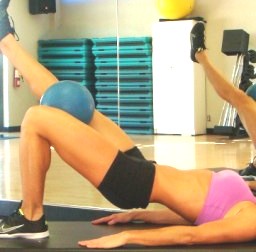
There are several different types of exercise to choose from when adding an exercise routine to your daily lifestyle. This being said, prior to deciding on a type of fitness to regularly perform, you will want to define your personal fitness goals and thereafter, determine the exercise type that best targets those goals.
If achieving improved overall core strength and toned, defined abdominals is one of your primary health and fitness goals, you are probably participating in some type of fitness program that includes regularly performing plenty a fair number of sit-ups, knee raises, and abdominal crunches. Although you are obviously on the right track, new research suggests that too many individuals with these types of core fitness workouts forget to incorporate exercises for the core area that specifically target the muscles of their back.
According to Peter Park and Dr. Eric Goodman, co-authors of a new book entitled Foundation: Redefine Your Core, Conquer Back Pain, and Move with Confidence, most people already spend plenty of time in their daily lives contracting their abs, pushing their shoulders forwards, and subsequently putting little to no resistance on their back muscles.
This occurs when you’re driving your car, sitting on the couch watching television, surfing the Web on a computer, and sitting at a desk at work. Goodman says that the key to true overall core strength is to exercise the back regularly, which, in turn, strengthens the spine and improves overall posture.
Targeting Your Back when Performing Core Exercises
Pivoting from the Pelvis
The exercises outlined in Goodman and Park’s book treat the spine as the body’s core, with movement typically originating from the hip joints, hips and pelvis. Park said that many of the exercises also focus on the buttocks. Given that many of the book’s suggested exercises are highly original and in some cases virtually unprecedented, it’s important to note Park’s credentials: he serves as strength and conditioning coach to Lance Armstrong, the winner of seven Tour de France cycling races. Park said that Armstrong, who penned the book’s foreword, uses the exercises on a regular basis.
Augmentation, Not Replacement
Dr. Goodman stressed that the exercises for the core suggested in the book should augment, and not replace, your current health and fitness regimen. Given the relatively high difficulty of the “foundation” exercises, Goodman said that even 20 minutes at a time is more than enough, especially if you’re incorporating the new exercises into a routine that already includes cardiovascular, strength training, Pilates and/or yoga.
The “Real Core”
American College of Sports Medicine spokesperson Neal Pire echoed Goodman and Park’s sentiments, saying that the concept of maintaining a neutral spine position while loading the posterior chain is highly important to building core strength and improving posture. He also agreed that the “core” of the body is better defined as the back as opposed to the abs.
Pire said that the core of the body is really made up of two different sets of muscles: shallow ones and deeper ones. The shallow muscles are primarily used to facilitate movement, while the deeper muscles are tasked with stabilizing the trunk of the body, and more specifically the spine.
4:1 Ratio?
Goodman and Park take the rather extreme approach of stating that for every set of exercises for the core you perform targeting your abs and the front of your body, you should do four more for your back. Although such a suggestion might lead some to overcompensate and place too little emphasis on their abs, the pair agreed that it was a good rule of thumb for those who currently forgo back exercises entirely.
Exercising Your Back: The Bottom Line
It’s simple: a fitness regime that focuses exclusively on the front of your body at the expense of your back cannot be classified as a comprehensive core routine. Even if your goal is only to tone your abs, you’ll be cheating yourself if you finish your workout sessions without exercising your back.